Geometrical Seamless Patterns Bundle: A Practical Evaluation for Designers and Creators
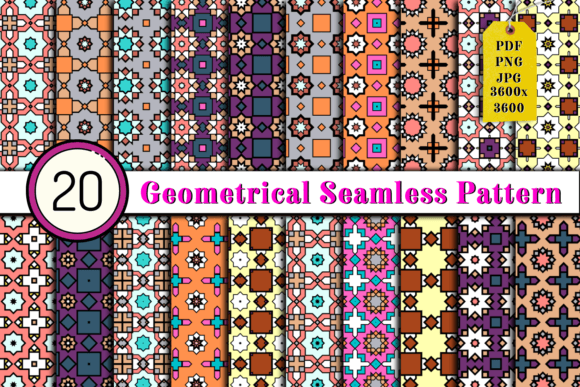
A Geometrical Seamless Patterns Bundle is a curated digital collection of 20 high-resolution, tileable pattern files designed to repeat infinitely without visible seams. Each pattern is delivered in both PNG (with transparency support) and JPG formats, sized at 5000×5000 pixels—offering flexibility across print, web, and screen-based applications. Unlike generative tools or single-pattern downloads, this bundle provides immediate, production-ready assets with consistent quality and intentional visual cohesion.
What Sets This Bundle Apart from Other Pattern Resources
Not all seamless pattern collections are built the same. Many free or low-cost options rely on algorithmic tiling, resulting in repetitive motifs, inconsistent spacing, or subtle alignment artifacts that become apparent at larger scales. In contrast, the Geometrical Seamless Patterns Bundle prioritizes hand-refined geometry—clean lines, balanced negative space, and deliberate symmetry or asymmetry. The patterns avoid overused tropes (like generic hex grids or basic triangles) in favor of nuanced variations: overlapping angular lattices, offset diamond fields, modular tessellations, and rhythmically staggered polygons.
The 5000×5000 resolution supports scaling without pixelation—even when stretched across large-format wall murals or printed at 300 DPI for signage. Transparency in PNG files enables non-destructive layering in design software (e.g., Photoshop or Figma), while JPGs offer lightweight compatibility for CMS backgrounds or email templates. This dual-format delivery addresses real-world workflow needs, not just theoretical convenience.
Practical Use Cases—and Where It Fits Best
The Geometrical Seamless Patterns Bundle excels where consistency, scalability, and visual clarity matter most:
- Interior and spatial design: Applied as wall coverings, cubicle dividers, or floor plan overlays—especially effective in modern office environments seeking subtle texture without visual clutter.
- Digital interfaces: Backgrounds for app screens, dashboard headers, or button mockups benefit from the geometric precision, which aligns cleanly with UI grid systems and doesn’t compete with typography or icons.
- Branding and marketing assets: When building cohesive visual identities, these patterns serve as unobtrusive yet distinctive textural layers behind logos, product shots, or social media banners.
- Print and packaging: Though not vector-based, the high-resolution raster files hold up well for spot textures on business cards, presentation decks, or limited-run packaging prototypes.
It’s less suited for scenarios requiring infinite scalability (e.g., SVG-based responsive web backgrounds) or deep customization—such as adjusting individual line weights or recoloring specific elements mid-pattern. For those needs, vector pattern generators or custom Illustrator brushes may be more adaptable.
Comparison With Alternative Approaches
Designers often weigh pre-made bundles against other solutions:
- Free pattern libraries (e.g., Subtle Patterns or public domain repositories) offer variety but rarely guarantee uniform resolution, color harmony, or seamless reliability across all 20+ files. Users frequently spend time testing, resizing, or re-exporting—offsetting the initial cost savings.
- AI-generated pattern tools produce novelty quickly but lack intentionality: motifs may feel arbitrary, color palettes inconsistent, and tiling behavior unpredictable without manual correction. They also raise licensing questions for commercial use.
- Custom pattern creation gives full control but demands significant time investment—not just for drawing, but for rigorous seam testing, resolution optimization, and format export. For time-constrained projects, this tradeoff rarely favors in-house development.
- Subscription-based pattern services provide ongoing access but often limit downloads per month or restrict commercial usage rights. A one-time purchase like the Geometrical Seamless Patterns Bundle offers ownership clarity and no recurring fees—valuable for freelancers managing multiple client contracts.
The bundle occupies a pragmatic middle ground: more reliable than free sources, more efficient than AI or custom work, and more straightforward than subscription models.
Realistic Strengths and Limitations
Strengths include its focused scope (20 thoughtfully composed patterns, not 200 diluted variants), consistent technical specs, and broad format support. Because each file is individually tested for seamless repetition, users avoid the common frustration of discovering alignment flaws after hours of layout work.
Limitations are equally practical: it’s raster-only, so it won’t scale infinitely like SVG. It doesn’t include editable source files (e.g., .AI or .PSD layers), meaning motif-level edits aren’t possible without recreating the pattern manually. And while the geometrical theme is cohesive, it doesn’t cover organic, hand-drawn, or illustrative styles—if your project calls for fluid brushwork or textured grain, this isn’t the right fit.
When to Choose This Bundle—and When to Look Elsewhere
This Geometrical Seamless Patterns Bundle makes sense if you’re working on:
- A branding refresh needing clean, professional background textures across web, print, and environmental applications;
- An interior design proposal where consistent, scalable wall treatments must render accurately at different sizes;
- A mobile app redesign requiring subtle, non-distracting interface backdrops that complement rather than overwhelm content;
- A freelance gig with tight deadlines and clear commercial usage requirements.
Consider alternatives if:
- You need patterns that adapt responsively to any screen size—look for SVG-based solutions or CSS-native tiling;
- Your project relies heavily on color variation per pattern—you’ll need editable vector files or a tool that supports live recoloring;
- You require highly specialized geometry (e.g., Islamic tile motifs, Penrose tilings, or parametric fractals)—a niche library or custom commission may better match your aesthetic goals;
- Budget is the sole constraint and your use case allows for lighter-weight, lower-resolution assets (e.g., small social media graphics).
How to Integrate These Patterns Efficiently
Applying the patterns is straightforward, but technique affects outcome. For web or app mockups, placing the pattern as a CSS background image with background-repeat: repeat ensures true tiling. In design software, using blend modes like Screen or Multiply over photos or illustrations creates depth without obscuring underlying content—just as the description notes. For print prep, verify that your RIP or printer driver respects the embedded color profile (sRGB for digital, CMYK-converted for offset printing) to maintain fidelity.
Because all 20 patterns share the same dimensions and format structure, batch-processing—such as applying consistent color adjustments or exporting for different platforms—is significantly faster than managing disparate assets.
Final Considerations for Informed Decision-Making
A Geometrical Seamless Patterns Bundle isn’t a universal solution—but it is a purpose-built tool. Its value lies in reducing friction between concept and execution, especially when geometric clarity, professional polish, and time efficiency are priorities. If your workflow regularly involves filling large areas with repeatable texture—or if you’ve spent too long searching, testing, and troubleshooting free alternatives—it represents a measured investment in reliability.
Before purchasing, review sample previews at actual size (not thumbnails) and test one pattern in your intended environment—whether that’s a Figma prototype, a WordPress header, or a large-format print proof. That hands-on check reveals more than any description: how the geometry interacts with your content, how the resolution holds up under your output conditions, and whether the visual tone matches your project’s intent.