A Set of Christmas Seamless Patterns: A Practical Evaluation for Designers and Makers
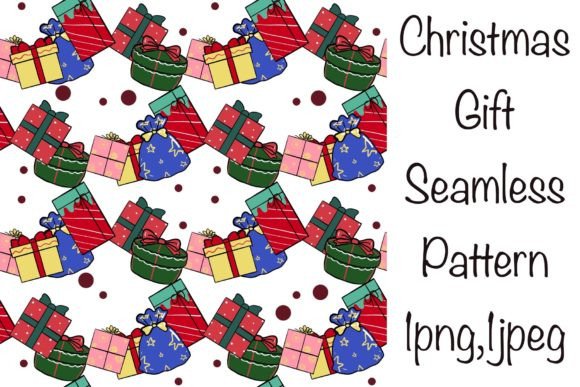
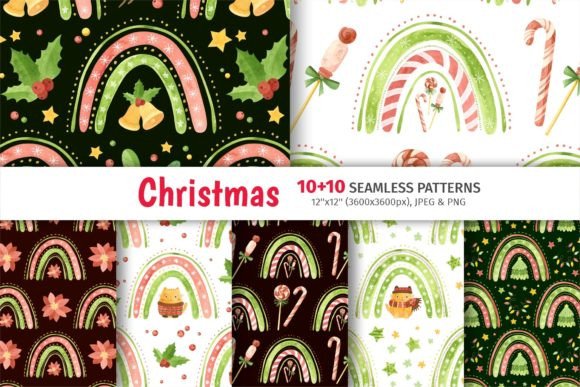
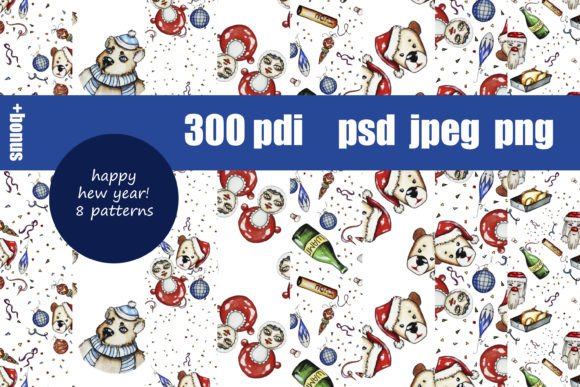
When preparing holiday-themed products—whether custom mugs, gift wrap, fabric banners, or printable cards—seamless patterns offer efficiency, visual cohesion, and professional polish. A Set of Christmas Seamless Patterns is a curated collection of eight original, hand-drawn designs, each developed manually and refined in Photoshop. Unlike algorithmically generated or clip-art-based alternatives, these patterns emphasize organic line work, thoughtful spacing, and seasonal authenticity—think stylized holly sprigs, minimalist snowflakes, warm candle motifs, and textured fir branches—not generic icons.
What Makes This Collection Distinctive
The manual creation process is central to its value. Each illustration begins as physical sketching or digital hand-drawing, then undergoes careful vectorization and raster editing in Photoshop—not automated tiling or AI-assisted generation. That origin shows in subtle variations: slight irregularities in leaf curvature, uneven stroke weight in inked outlines, and intentional negative space that avoids visual fatigue when repeated across large surfaces. These are not “plug-and-play” decorations; they’re crafted assets meant to hold up under close inspection and scale.
Delivery includes three essential formats: layered PSD files (for non-destructive editing), high-fidelity JPGs (ideal for web previews or quick mockups), and PNGs with transparent backgrounds (critical for overlaying on colored substrates or sublimation blanks). All files are rendered at 300 dpi, meeting industry standards for print production on textiles, ceramics, stationery, and signage.
How It Compares to Other Pattern Sources
Many designers start by searching free pattern libraries or subscription-based platforms. Those options often prioritize volume over nuance—hundreds of patterns, but few with consistent style, cohesive color palettes, or true scalability. Others rely on vector tile scripts in Illustrator, which produce technically seamless results but can feel rigid or repetitive due to symmetry constraints. In contrast, A Set of Christmas Seamless Patterns balances technical reliability with artistic intention: every repeat aligns precisely, yet retains expressive qualities that avoid mechanical monotony.
Compared to single-illustration packs, this set offers immediate versatility. You’re not buying one snowflake motif and needing to build your own repeat—each of the eight patterns is fully tiled and tested. That saves time during layout phases, especially when designing across multiple product types (e.g., matching napkins, tote bags, and greeting cards). However, it also means less flexibility than raw vector elements you’d assemble yourself—a tradeoff between speed and granular control.
Use Cases Where This Set Excels
- Small-batch product creators: If you’re printing on ceramic mugs via sublimation, the 300 dpi PNGs ensure crisp detail without pixelation—even on curved surfaces. The transparent background eliminates unwanted white halos around motifs.
- Stationery designers: For letterpress or foil-stamped cards, the clean JPG and PSD layers let you adjust contrast, invert colors, or isolate elements before prepress—without relying on third-party converters.
- Textile printers: The seamless nature means no visible seams when scaled across yardage. Unlike some SVG-based repeats that break at certain resolutions, these raster patterns maintain fidelity whether used on a 4" sticker or a 48" wall banner.
- Educators and workshop leaders: Because all files are editable in widely accessible software (Photoshop, GIMP, Affinity Photo), they serve well as teaching tools—demonstrating layer management, resolution awareness, and repeat construction without requiring advanced vector knowledge.
Tradeoffs to Consider Before Choosing
This set does not include editable vector files (AI, EPS, or SVG), so if your workflow depends on infinite scalability or precise path manipulation—say, for laser-cut stencil design or embroidery digitizing—you’ll need to trace or convert manually. While the PSD files retain layers, they’re raster-based; resizing beyond 120% may introduce softness, particularly in fine linework. That’s rarely an issue for standard print applications, but matters for oversized murals or ultra-high-resolution packaging.
Color is another consideration. The patterns ship in grayscale or muted seasonal tones (deep forest green, cream, charcoal, rust)—not full RGB swatches. That gives you freedom to recolor in Photoshop, but requires basic familiarity with adjustment layers or blending modes. It’s not “drag-and-drop color change,” but rather a deliberate, controllable process. Users expecting ready-made Pantone-matched versions for brand consistency will need to calibrate separately.
When Another Option Might Be Better
- You need vector scalability above all else. If your primary use is large-format signage or scalable embroidery files, a vector-based Christmas pattern pack—or hiring an illustrator for custom vector repeats—may better suit long-term needs.
- Your project demands strict brand-color compliance. While recoloring is straightforward, it adds a step. If you’re managing dozens of SKUs with exact CMYK specifications, pre-built color variants would reduce QA overhead.
- You’re building a library for multiple holidays or themes. This set is Christmas-specific and stylistically unified. If you regularly switch between Easter, Halloween, and botanical themes, a modular system—like individual illustrated elements you tile yourself—offers more long-term adaptability.
- You’re new to pattern application and need guided workflows. Though well-structured, the files assume foundational Photoshop competence. Beginners may find video tutorials or template-based services more supportive initially.
Realistic Integration Examples
A small stationery brand used four patterns from A Set of Christmas Seamless Patterns to create a coordinated suite: a subtle holly-repeat for envelope liners (PNG, 50% opacity), a bold candle motif for wax seal impressions (JPG, inverted and sharpened), and two lighter textures for gift tag backgrounds (PSD layers adjusted for contrast). Because all files shared the same resolution and bleed behavior, their printer reported zero alignment issues across 12 product SKUs.
Similarly, a textile designer applied the fir branch pattern across cotton tea towels using sublimation. The 300 dpi resolution prevented blurring at seam lines, and the manual drawing quality gave the final product a hand-printed aesthetic—distinct from mass-produced digital prints. Customers noted the “lived-in warmth” of the repeat, attributing it to the organic rhythm of the original linework.
Making an Informed Decision
Choosing A Set of Christmas Seamless Patterns isn’t about finding the “best” Christmas graphics—it’s about matching asset characteristics to your actual workflow, output requirements, and creative goals. Its strengths lie in authenticity, print readiness, and cross-format consistency—not breadth of styles or automation. If you value human-crafted detail, work primarily in raster-based environments, and prioritize reliable performance across physical products, this set delivers tangible utility.
But if your needs center on vector precision, multi-holiday flexibility, or turnkey color variants, evaluating hybrid approaches—such as pairing one pattern from this set with custom vector elements—may yield a more tailored outcome. Ultimately, the most effective resource isn’t the one with the most features, but the one whose constraints align with your real-world constraints—and whose craftsmanship supports, rather than competes with, your own.