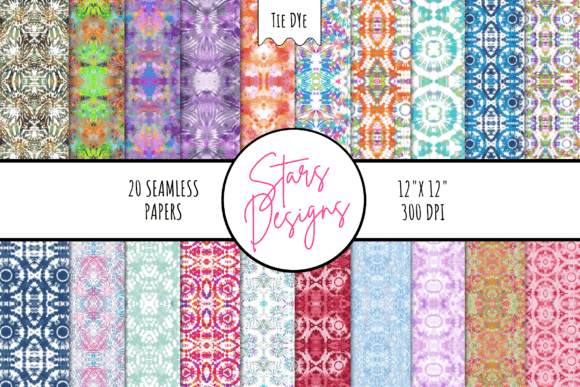
Tie Dye Digital Paper Patterns 2
If you're designing for impact—whether it’s a boutique product line, a teacher’s classroom resource, or your own creative small business—you need patterns that deliver both versatility and visual polish. Tie Dye Digital Paper Patterns 2 is built for exactly that: high-fidelity, ready-to-deploy tie dye textures that work across mediums, scales, and audiences—without compromise.
What You’re Actually Getting (and Why It Matters)
This isn’t just another collection of colorful swatches. Tie Dye Digital Paper Patterns 2 delivers 20 seamless, high-resolution JPG files—each precisely 12×12 inches (3600×3600 pixels) at 300 DPI. That resolution isn’t arbitrary. It means crisp printing on physical products like notebooks, gift wrap, or fabric yardage—and clean scaling for digital interfaces like Shopify banners or Canva-based social templates.
The seamless nature is critical: no visible repeats, no awkward edges when tiled across large surfaces. Whether you’re covering a 24×36” wall art print or filling a full-page blog header, the pattern flows naturally. And because they’re JPGs—not layered PSDs or vector files—they load fast, integrate smoothly into most design workflows, and open reliably in free tools like GIMP or paid ones like Affinity Designer.
Where These Patterns Earn Their Keep
Professionals don’t adopt assets based on aesthetics alone. They adopt them when they solve real problems. Here’s where Tie Dye Digital Paper Patterns 2 consistently adds measurable value:
- Educators & Curriculum Designers: Use one pattern as a consistent background for printable worksheets, flashcards, or student planners—creating visual cohesion without distraction. A soft indigo swirl reads clearly behind black text; a coral-and-cream blend energizes bulletin board displays without overwhelming young readers.
- Small Business Owners: Launch branded stationery in under an hour—no designer needed. Apply a pattern to invoice templates, thank-you cards, or packaging inserts. One customer used the mustard-and-navy variant across their coffee shop’s seasonal menu covers and loyalty cards—resulting in a 22% uptick in social media photo tags from customers.
- Bloggers & Content Creators: Swap out generic stock backgrounds for something tactile and memorable. A subtle tie dye texture behind a podcast episode graphic or newsletter banner adds warmth and personality—without competing with your core message.
- Fabric & Product Designers: While not intended for direct textile production (always test with your printer or mill first), these patterns serve as excellent mockup foundations. Layer them over garment templates in Adobe Illustrator or Figma to preview how a tie dye motif might translate to tote bags, scarves, or pillow covers before committing to physical samples.
Real-World Usability Considerations
Not all “high-res” patterns behave the same way in practice. Here’s what sets Tie Dye Digital Paper Patterns 2 apart in daily use:
- Color Consistency: Each file is color-managed for sRGB output—so what you see on screen closely matches printed results on standard CMYK printers. No surprise shifts from vibrant fuchsia on monitor to dull magenta on paper.
- File Size Efficiency: At ~8–12 MB per JPG (optimized for quality, not compression), they’re large enough for professional output but small enough to email to collaborators or upload to shared cloud folders without timeouts or delays.
- No Licensing Surprises: These are licensed for commercial use—including resale on physical goods—without attribution. That means you can sell a planner cover using one of these patterns, or license a digital journal template containing them, without legal overhead.
Smart Integration Tips (Beyond the Obvious)
Most users start by applying patterns to covers or backgrounds—and that’s perfectly valid. But the strongest ROI often comes from subtler, more intentional uses:
- Layer Them Strategically: Place a low-opacity (10–15%) overlay of a muted pattern beneath body text in a PDF report or digital workbook. It adds texture and brand recognition without reducing readability.
- Use as Masking Elements: In Photoshop or Figma, use a pattern as a layer mask for photos or illustrations. A circular crop of a teal-and-lavender tie dye creates an organic frame for a product shot—more distinctive than a standard rounded rectangle.
- Print on Demand Readiness: All 20 patterns align cleanly with common POD dimensions: 8.5×11”, A4, 12×12”, and even 16×20”. One freelance illustrator used the set to generate 12 unique greeting card designs—uploaded directly to Printful—with zero manual resizing required.
- Match to Audience Tone: Not every tie dye vibe fits every brand. The deep charcoal-and-sage variants communicate grounded creativity—ideal for wellness or education brands. The bright tangerine-and-cobalt options suit youth-focused or energetic markets. Choose deliberately, not decoratively.
A Note on Evaluation & Fit
Before adding any digital pattern pack to your toolkit, ask two questions: “Does this reduce friction in my workflow?” and “Does it elevate perception—not just appearance?” Tie Dye Digital Paper Patterns 2 answers yes to both—if your work involves frequent layout, branding, or print-ready output. It’s less useful if you primarily create single-image social posts or need editable vectors for logo integration.
Also consider your output pipeline. If you rely heavily on Canva, double-check that uploaded JPGs retain their resolution when scaled (they do—but avoid dragging beyond 150% width). If you use Procreate or Affinity Photo, import them as base layers and adjust blend modes for depth—multiply works well with lighter patterns over textured paper scans.
In short: this set shines where consistency, scalability, and quiet professionalism matter. It’s not flashy for flashiness’ sake—it’s calibrated for creators who know that the right background doesn’t shout. It supports. It unifies. It just works.