Lilac Lime Seamless Patterns: A Versatile Digital Resource for Creative Professionals and Crafters
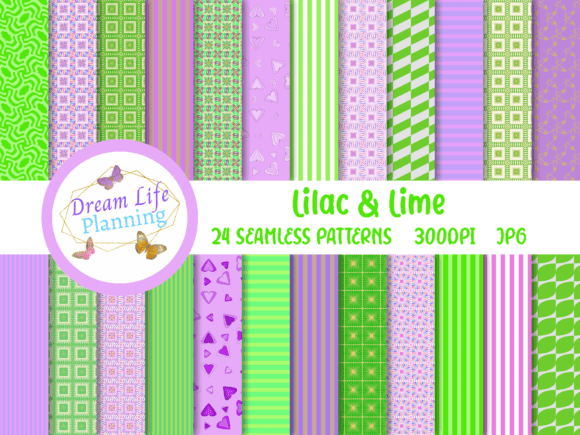
Color psychology tells us that lilac evokes calm creativity and quiet sophistication, while lime green pulses with energy, optimism, and modern vibrancy. When combined in balanced, intentional harmony—as they are in the Lilac Lime Seamless Patterns collection—they form a dynamic chromatic pairing uniquely suited to contemporary design needs. This curated set of 24 high-resolution digital papers isn’t just another pattern pack; it’s a thoughtfully engineered toolkit built for scalability, adaptability, and aesthetic cohesion across physical and digital outputs.
What Makes These Patterns “Seamless”—And Why It Matters
The term “seamless” is often used loosely in digital design, but in practice, it carries precise technical meaning. A truly seamless pattern repeats without visible breaks, edges, or misaligned transitions—no ghost lines, no pixelated joins, no color shifts at tile boundaries. The Lilac Lime Seamless Patterns were constructed using vector-based planning and pixel-perfect raster refinement to ensure flawless tiling at any scale. Each pattern is delivered at 12 × 12 inches and 300 dpi—a resolution standard that supports both fine-detail print applications (like embossed book covers or foil-stamped invitations) and large-format output (such as fabric yardage or wall murals).
This technical fidelity unlocks real-world flexibility. For example, a graphic designer preparing branding assets for a summer wellness retreat can use one striped variant as a subtle background for presentation decks—and then extend the same pattern across custom tote bags and event banners without reworking or scaling compromises. Similarly, an educator creating printable classroom resources can apply a soft abstract lilac-lime motif to flashcards, worksheets, and digital slide backgrounds, maintaining visual continuity across modalities.
Diverse Pattern Language: Abstract Meets Structured Rhythm
The collection balances two complementary design sensibilities: 12 abstract patterns and 12 striped variations. The abstract group includes watercolor washes with granulated texture, geometric overlays with soft diffusion, organic stippling, and layered translucent shapes—all grounded in the same constrained, harmonious palette. These aren’t random splashes of color; each composition follows deliberate spatial principles—rhythmic density variation, intentional negative space, and controlled saturation gradients—to avoid visual fatigue.
The striped subset demonstrates equal intentionality. These aren’t simple parallel lines. They include alternating widths, staggered offsets, micro-dashed interruptions, tonal banding (e.g., lilac-to-mauve transitions within a single stripe), and subtle opacity shifts that create depth. One pattern features narrow lime stripes intersecting broader lilac bands at 15-degree angles, producing an understated moiré effect when tiled—ideal for modern stationery or tech-themed presentations.
This duality serves distinct creative workflows. Abstract patterns excel where emotional resonance and tactile suggestion matter—think journal covers evoking summer gardens or mindfulness prompts printed on textured cardstock. Striped variants thrive in contexts demanding clarity, structure, or directional emphasis—such as timeline infographics, section dividers in digital planners, or border elements that guide the eye without dominating content.
Practical Applications Across Industries and Skill Levels
Because the Lilac Lime Seamless Patterns operate at the intersection of aesthetics and utility, their application spans far beyond traditional craft circles:
- Small Business Owners: Use the patterns to unify branded merchandise—design matching labels for artisanal skincare products, cohesive packaging inserts for subscription boxes, or consistent social media post templates that reinforce seasonal campaigns.
- Educators and Instructional Designers: Integrate tiled backgrounds into printable learning kits, interactive PDFs, or LMS dashboards. The high contrast between lilac and lime ensures readability even when overlaid with semi-transparent text boxes or icons.
- Textile and Surface Designers: Import the JPG files directly into pattern-making software (like Adobe Illustrator’s Pattern Maker or Procreate’s Canvas Repeat mode) to develop repeat swatches for fabric printing, ceramic decals, or wallpaper mockups—no additional interpolation needed.
- Book Artists and Journal Makers: Print individual tiles at varying opacities onto mixed-media paper, then collage, stitch, or emboss over them. The predictable repetition allows for precise alignment when creating multi-page spreads or accordion-fold structures.
- Digital Product Creators: Embed patterns as CSS background images with
background-repeat: repeat;for web-based planners, Notion templates, or Canva brand kits—ensuring responsive tiling across device sizes without loading multiple assets.
A notable advantage lies in accessibility-conscious implementation. Unlike overly saturated neon palettes, the lilac-lime combination meets WCAG 2.1 contrast guidelines when paired with dark charcoal or deep navy typography. Designers working on inclusive educational materials or public-facing event collateral can rely on this set without sacrificing visual appeal or compliance.
Technical Considerations for Optimal Use
While the Lilac Lime Seamless Patterns are optimized for broad compatibility, informed usage enhances results:
First, understand file format implications. JPG delivery ensures universal software support (Photoshop, Affinity Photo, Cricut Design Space, Silhouette Studio, GIMP), but lacks transparency. If layering over photos or complex illustrations, consider converting to PNG via your editing software—preserving edges without adding white fill. Second, respect resolution context: although 300 dpi is standard for print, screen-based projects benefit from exporting at 72–150 dpi to reduce file size without perceptible quality loss.
Third, test tiling behavior before finalizing large runs. In Photoshop, use Filter > Other > Offset with the “Wrap Around” option enabled to preview edge alignment. In vector tools, create a 2×2 tile grid and zoom to 400% to inspect junction points. This step prevents costly surprises—especially critical when ordering fabric prints or architectural-scale wallpaper.
Finally, consider color management. The patterns were created in sRGB color space, ensuring consistency across consumer-grade monitors and most commercial printers. However, if outputting to wide-gamut devices (e.g., professional photo printers or textile dye-sublimation systems), soft-proofing against the target profile helps anticipate subtle shifts in lilac warmth or lime intensity.
Why This Palette Resonates in Current Creative Contexts
The lilac-lime combination reflects broader trends in visual culture—not as fleeting fads, but as responses to evolving environmental and psychological needs. In interior design, these hues appear in biophilic spaces that merge botanical softness (lilac’s floral association) with technological vitality (lime’s digital-age connotation). In branding, they signal approachable innovation—think edtech startups targeting K–12 educators or sustainable fashion labels appealing to Gen Z consumers who value both authenticity and energy.
Moreover, this palette avoids the visual exhaustion associated with overused combinations like mint-and-rose or cobalt-and-sunshine yellow. Its relative freshness means designs stand out in crowded digital feeds or craft fairs without relying on novelty alone. A party invitation using the watercolor abstract pattern reads as intentionally serene rather than generically cheerful; a scrapbook layout with the diagonal striped variant feels rhythmically grounded rather than merely decorative.
Integrating Into Existing Workflows Without Disruption
Adopting new assets often introduces friction—learning curves, template overhauls, or inconsistent outputs. The Lilac Lime Seamless Patterns minimize this through interoperability and predictability. Because all 24 patterns share identical dimensions, resolution, naming conventions (e.g., LL_Abstract_07.jpg, LL_Stripe_12.jpg), and color-space calibration, users can batch-import into libraries, automate folder organization via scripts, or build standardized layer styles in design software.
For teams, this uniformity supports version control and collaborative editing. A marketing team can assign one striped pattern as the “Q2 Campaign Base” across Canva, Figma, and InDesign files—knowing that exports will align visually whether viewed on mobile, projected in meetings, or printed on signage. For solo creators, the consistency reduces decision fatigue: choosing a pattern becomes about expressive intent (“Do I need movement or stillness here?”) rather than technical guesswork (“Will this scale without blurring?”).
In essence, the Lilac Lime Seamless Patterns function less like static graphics and more like a living design system—one that grows with its users’ evolving needs, scales across mediums, and maintains integrity whether applied to a 2-inch bookmark or a 10-foot trade show backdrop.