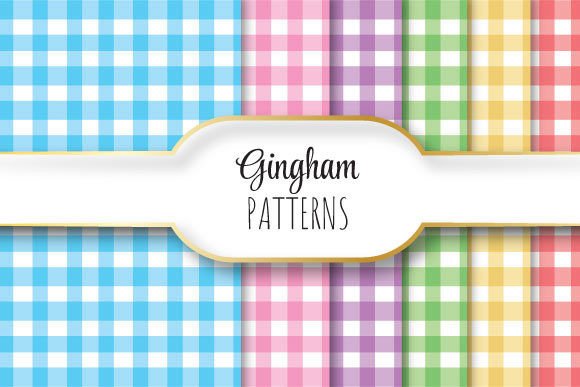
Gingham Patterns Reimagined: Precision Vector Resources for Professional Design Workflows
Gingham Patterns have long held a quiet but persistent place in visual culture—evoking pastoral charm, textile tradition, and structured rhythm. Yet their modern utility extends far beyond nostalgic aesthetics. Today’s designers, educators, and product developers rely on rigorously engineered digital interpretations: seamlessly repeating vector patterns built to exacting technical specifications. This shift—from hand-drawn motif to production-grade asset—represents more than convenience. It reflects an evolution in how pattern integrity, scalability, and cross-platform compatibility are prioritized across disciplines.
Technical Foundation: Why 3600 × 3600 Pixels at 300 DPI Matters
The stated dimensions—12 × 12 inches at 300 dpi—anchor these Gingham Patterns in real-world output fidelity. A 3600 × 3600 pixel raster grid isn’t arbitrary; it ensures crisp rendering across high-resolution print applications: packaging mockups, fabric swatch books, architectural presentation boards, and large-format signage. Unlike low-res web tiles that blur or pixelate when scaled, this resolution preserves edge clarity and color consistency even when enlarged by 200% in layout software.
Crucially, the inclusion of EPS 10 files adds a layer of future-proof flexibility. EPS (Encapsulated PostScript) remains one of the most universally supported vector formats across Adobe Creative Suite, CorelDRAW, Affinity Designer, and prepress workflows. Version 10 compatibility guarantees backward support for legacy systems while retaining modern features like transparency groups and gradient meshes—essential for nuanced gingham variations that simulate fabric depth or subtle tonal shifts.
Seamlessly Repeating Vector Patterns: Beyond Visual Continuity
“Seamless” is often used loosely—but here, it denotes mathematical precision. Each pattern tile is constructed so that its left edge aligns perfectly with its right, and its top matches its bottom—no visible seams, no manual alignment required. This isn’t achieved through simple tiling tricks or opacity masks. Instead, anchor points, path directions, and stroke weights are calibrated to eliminate micro-gaps or overlapping geometry that can trigger rendering artifacts in RIP (Raster Image Processor) engines.
Consider a textile designer developing a capsule collection. Using a seamless vector gingham means they can map the pattern directly onto 3D garment simulations without distortion at seam allowances. Or imagine an educator preparing a lesson on symmetry in mathematics: the predictable repetition allows students to isolate unit cells, measure frequency intervals, and annotate transformation rules (translation, reflection, glide reflection) with measurable accuracy—not just visual approximation.
Practical Implications of Dual-Format Delivery
The ZIP package contains six EPS files and six corresponding JPEGs—a deliberate pairing, not redundancy. The EPS files serve as editable, infinitely scalable sources. Designers adjust line weight, recolor individual stripes, or embed the pattern into complex compound paths without generational loss. Meanwhile, the JPEGs—also 3600 × 3600 pixels—function as reliable preview assets, texture overlays in non-vector tools (like Procreate or Figma via image fills), or placeholders in CMS environments where SVG or EPS upload isn’t supported.
This dual delivery supports hybrid workflows. A branding agency might use the EPS to build a custom stationery suite in Illustrator, then drop the JPEG into a WordPress theme background for consistent visual continuity—even if the site builder doesn’t accept vector uploads. Similarly, a researcher compiling a comparative study of pattern density across cultures could import JPEGs into image analysis software (e.g., ImageJ) for pixel-based measurements, while using EPS data to extract vector path metrics like stripe width variance or corner angle deviation.
User-Centric Applications Across Domains
The versatility of these Gingham Patterns emerges not from abstraction, but from concrete use cases shaped by diverse professional needs.
- Product Designers: Integrate gingham vectors into CAD surface mapping for consumer goods—think laptop sleeves, ceramic mugs, or modular furniture panels—where repeat alignment must survive curvature calculations and UV unwrapping.
- Educators & Curriculum Developers: Leverage the fixed grid structure to teach foundational concepts: Cartesian coordinates, ratio (e.g., 1:1 check vs. 2:1 stripe proportion), and tessellation logic. The uniform 12-inch canvas provides a tangible scale reference—students measure real-world equivalents using rulers or digital calipers.
- Textile & Surface Designers: Use the EPS files as base layers for overprinting techniques—layering halftone dots, foil stamping masks, or reactive dye boundaries—all while preserving the underlying gingham’s registration integrity.
- UX/UI Designers: Apply JPEG variants as subtle, accessible background textures in dashboards or admin interfaces. At 300 dpi, they retain legibility behind semi-transparent UI elements without introducing visual noise or performance lag associated with heavy SVG filters.
- Hobbyists & Makers: Import EPS files into Cricut Design Space or Silhouette Studio for precise cut files—ideal for quilting templates, laser-cut wood inlays, or vinyl decals where millimeter-level accuracy affects final assembly.
Observations from Real Implementation
In practice, users consistently note two underappreciated advantages: predictability and interoperability. Predictability refers to how reliably the pattern behaves across software versions. Because EPS 10 avoids newer, less stable features (like variable fonts or complex blend modes), a file opened in Illustrator CS6 behaves identically to one opened in CC 2024—critical for collaborative studios with mixed software licenses.
Interoperability manifests in quieter ways. For example, a university lab using open-source tools like Inkscape can open and edit the EPS files without conversion loss, while commercial printers accept them natively in imposition software like Kodak Prinergy. Even non-design applications benefit: architects importing the JPEGs into Revit as decal families report improved texture stability during model rotation—no “swimming” effect common with low-resolution repeats.
Design Integrity Meets Functional Rigor
What distinguishes these Gingham Patterns from generic online downloads is their adherence to functional constraints—not just visual ones. Each pattern respects a strict 12 × 12 inch bounding box, meaning no extraneous whitespace or off-canvas geometry interferes with automated tiling scripts. Stroke profiles follow industry-standard conventions: hairline strokes are avoided in favor of minimum 0.25 pt weights to ensure visibility in printed proofs. Color definitions default to CMYK builds optimized for coated stock, with optional RGB variants embedded where appropriate—no guesswork for color-managed output.
Moreover, the six included variants aren’t stylistic flourishes alone. They represent empirically useful increments: classic 1/8-inch checks, narrow 1/16-inch micro-gingham, wide 1/4-inch bistro-scale, asymmetric offset rows, dual-tone contrast sets, and tone-on-tone subtlety. This range supports decision-making grounded in application—not trend-chasing. A restaurant owner selecting table linens evaluates drape behavior against stripe width; a packaging engineer assesses how fine gingham interacts with flexographic plate wear; a motion graphics artist tests how scanline rendering handles tight vertical/horizontal alternation.
Workflow Integration Without Friction
Adoption hinges less on novelty and more on frictionless integration. These assets require no plugin, no subscription, no cloud sync. Drag the ZIP into a local folder, extract, and begin using—whether in a high-security government design lab with air-gapped systems or a student’s Chromebook running browser-based tools.
For teams managing version control, the discrete EPS/JPEG pairing simplifies asset tracking. Naming conventions follow ISO 8601 timestamps and descriptive modifiers (e.g., gingham_classic_3600x3600_cmyk_v20240517.eps), enabling script-driven batch processing. Design system managers embed them into token libraries as “pattern primitives,” linking metadata like repeat interval (in mm), base color space, and recommended minimum usage size—transforming decorative elements into documented, governable components.
Even accessibility considerations are embedded structurally. While gingham itself is a visual pattern, the vector construction allows screen readers to parse embedded titles and descriptions when exported to tagged PDFs. Educators repurpose the same files for tactile diagram creation—converting EPS paths to emboss-ready SVG for swell paper printers, supporting multi-sensory learning without re-creating the core geometry.
Looking Ahead: Pattern as Infrastructure, Not Decoration
As design systems mature and cross-disciplinary collaboration intensifies, the role of pattern assets is shifting. They’re no longer decorative afterthoughts but foundational infrastructure—akin to typography grids or color palettes. Gingham Patterns, in particular, offer a rare balance: cultural resonance paired with mathematical tractability. Their enduring appeal lies not in nostalgia, but in reliability—the assurance that a 12 × 12 inch tile will behave identically whether placed on a business card or a billboard, edited in 2024 or archived for 2034.
This collection doesn’t attempt to redefine gingham. Instead, it refines its execution—honoring its heritage while equipping professionals with tools calibrated for precision, longevity, and real-world resilience. Whether you’re calculating thread count ratios, teaching symmetry transformations, prototyping sustainable textiles, or building brand guidelines, the value resides in what the files enable—not what they depict.