10 Geometrical Seamless Patterns Bundle: A Practical Resource for Designers, Educators, and Everyday Creators
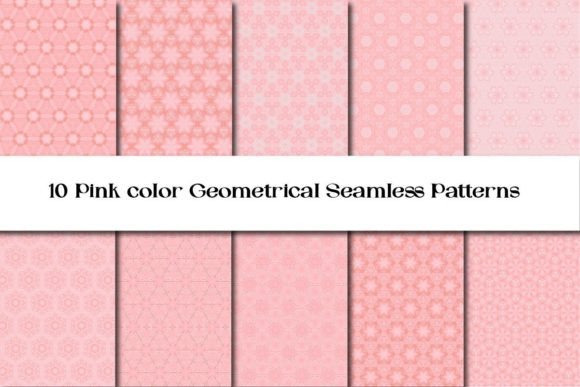
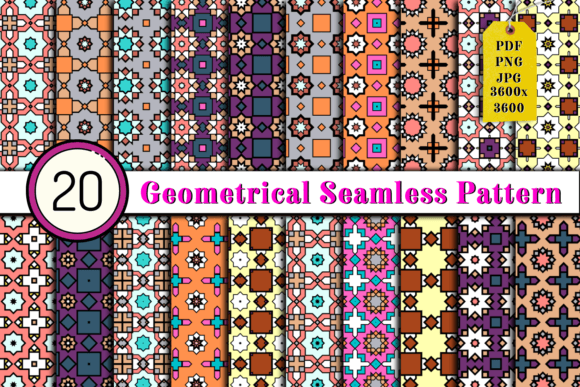
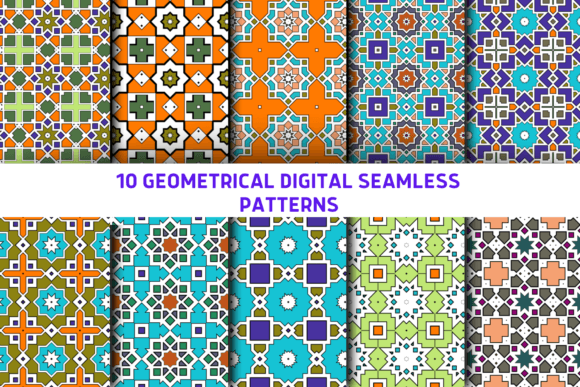
Seamless patterns are foundational tools in visual communication—quietly powerful, endlessly adaptable, and surprisingly versatile. Among the many digital pattern collections available today, the 10 Geometrical Seamless Patterns Bundle stands out not just for its aesthetic cohesion but for its functional precision and broad applicability across disciplines. Though the name references “10,” this bundle actually delivers 20 distinct geometrical seamless patterns, each crafted at high resolution (5000×5000 pixels) and supplied in both PNG and JPG formats. This detail matters: it means designers can scale confidently, educators can project clearly, and small-business owners can print crisp signage or branded merchandise without pixelation or tiling artifacts.
Why Geometry? Why Seamless?
Geometrical patterns tap into a deep-rooted human affinity for order, symmetry, and repetition. From Islamic tilework to mid-century modern textiles—and now to UI design systems and classroom visual aids—geometry communicates clarity, balance, and intention. When those geometrical motifs are seamless, they eliminate visible edges or breaks when tiled. That technical quality transforms them from decorative elements into structural assets: backgrounds that extend infinitely, textures that wrap around 3D mockups, or subtle overlays that unify disparate visual layers.
Unlike hand-drawn or organic patterns—which excel in warmth and irregularity—geometrical seamless patterns offer predictability and control. A hexagonal grid maintains consistent spacing across a full-screen web background. A diagonal line motif repeats flawlessly on a fabric swatch preview. A concentric circle pattern scales uniformly from a mobile app button to a trade-show backdrop. These aren’t just “pretty”—they’re engineered for reuse.
Real-World Applications Across Professions
The strength of the 10 Geometrical Seamless Patterns Bundle lies in how naturally it integrates into diverse workflows—not as a one-off graphic, but as a repeatable component in larger systems.
For Digital Designers & Developers
UI/UX professionals use these patterns to establish visual hierarchy without overwhelming users. A low-contrast triangular mesh can serve as a subtle background layer behind cards or modals, adding depth while preserving readability. Because each file is 5000×5000 pixels and offered in PNG (with transparency support), designers can easily apply overlays using blend modes like Screen, Multiply, or Overlay—a technique especially useful for creating textured buttons, app screens, or interactive prototypes. One designer recently used a diamond lattice pattern to reinforce a fintech dashboard’s sense of security and structure; another applied a minimalist dot grid as a non-distracting base for an educational e-learning platform.
For Educators & Instructional Designers
In classrooms—physical or virtual—visual consistency supports cognitive processing. Teachers use geometrical seamless patterns to create printable worksheets with built-in grids (for math or handwriting practice), themed slide backgrounds (e.g., a tessellated triangle pattern for a geometry unit), or tactile learning aids printed on cardstock. The high resolution ensures sharp projection during lessons, while the clean lines avoid visual clutter—a key consideration for neurodiverse learners. One elementary art instructor reported that students better grasped concepts like symmetry and translation by tracing over the repeating shapes in the bundle’s isometric grid and chevron files.
For Small Business Owners & Marketers
Branding doesn’t require a massive budget—just thoughtful consistency. A local café owner layered a soft geometric wave pattern over product photos for Instagram stories, instantly unifying her feed’s aesthetic. A freelance copywriter used a subtle diagonal stripe as a background for client proposal PDFs, reinforcing professionalism without sacrificing readability. Because the 10 Geometrical Seamless Patterns Bundle includes both PNG and JPG variants, users can choose based on need: PNG for layered composites with transparency, JPG for fast-loading web banners or email headers.
For Interior Designers & Facility Managers
Office environments increasingly prioritize visual calm and identity. Cubicle dividers, conference room walls, or reception area accents benefit from large-scale geometrical patterns that feel intentional—not random. Since each pattern is seamless and high-resolution, they translate cleanly to wall murals (via professional printing services) or vinyl decals. A corporate HR team recently refreshed their onboarding space using a monochrome tessellated hexagon pattern across three adjacent walls—creating continuity without monotony. The scalability of the 5000×5000 files meant no interpolation artifacts, even at 8-foot widths.
Technical Considerations That Matter
Not all seamless pattern bundles perform equally in real-world use. Several features of this collection directly address common pain points:
- No visible seams: Each pattern has been rigorously tested for edge alignment—critical when tiling across large surfaces or exporting for print.
- Format flexibility: PNG files preserve transparency for overlay work; JPGs offer smaller file sizes for web use where transparency isn’t needed.
- Resolution headroom: At 5000×5000 pixels, these files comfortably downscale for mobile or social media use while retaining fidelity for large-format output.
- Neutral color foundations: Most patterns are delivered in grayscale or muted palettes, making them easy to recolor non-destructively in Photoshop, Figma, or Illustrator via adjustment layers or hue/saturation controls.
- File organization: Clear naming conventions (e.g., “geo_pattern_dotted_grid_v2.png”) reduce time spent searching—especially valuable when managing dozens of design assets across projects.
How to Integrate These Patterns Into Your Workflow
Adoption is intentionally frictionless. You don’t need advanced software or custom scripts. Here’s how different users commonly apply them:
- Backgrounds: Drag a PNG into your design canvas, set blending mode to Normal, and resize to fill. For softer integration, lower opacity to 5–15%.
- Texture overlays: Place pattern above a photo layer, change blend mode to Screen (to reveal highlights) or Multiply (to emphasize shadows), then adjust opacity until texture enhances—not obscures—the underlying image.
- Print-ready assets: Import into Adobe InDesign or Affinity Publisher at 100% scale. Use the “Tile” feature in the Swatches panel to apply seamlessly across text frames or master pages.
- Web implementation: Convert to CSS background-image using data URIs (for small patterns) or link directly to optimized JPGs. Define
background-repeat: repeat;and let the browser handle tiling automatically. - Educational handouts: Insert into Google Slides or PowerPoint, right-click → “Format Background” → “Picture or texture fill” → “Insert” → select file. Adjust scale and tiling options within the pane.
Pattern Selection Tips for Specific Goals
With 20 options, choosing wisely saves time and strengthens outcomes:
- For readability-critical layouts (e.g., dashboards, presentations): Choose low-contrast patterns like fine dot grids or sparse line meshes. Avoid dense tessellations or high-frequency repeats near text blocks.
- For branding cohesion: Pick one dominant pattern and use variations (e.g., same base shape in different scales or opacities) across touchpoints—website header, email signature, and printed business cards.
- For tactile or physical applications (e.g., fabric, wallpaper, signage): Prioritize patterns with generous repeat units (larger tile dimensions) to minimize visible repetition at close range.
- For accessibility compliance: Steer clear of patterns with rapid flicker potential (e.g., tightly spaced alternating black/white lines). Opt instead for grayscale gradients or soft-edged geometries.
Looking Beyond Aesthetics: The Role of Pattern Literacy
Understanding how and why patterns function extends beyond software shortcuts. In architecture, geometry informs spatial flow. In data visualization, grid-based patterns help organize complex information. In cognitive science, repetitive visual structures reduce working memory load—making interfaces easier to navigate and lessons easier to retain. The 10 Geometrical Seamless Patterns Bundle serves as both a practical toolkit and a quiet entry point into that deeper literacy. It invites users to observe how line weight affects perception, how scale shifts emphasis, and how repetition builds familiarity—all without requiring formal training.
This isn’t merely a download—it’s a curated set of visual verbs. A dotted grid *organizes*. A concentric ring pattern *focuses*. A staggered triangle motif *directs the eye*. And because each is seamless, high-resolution, and format-flexible, those verbs remain effective whether you’re sketching on paper, coding a landing page, or planning a school mural.
Final Thought: Utility Over Novelty
In an era saturated with fleeting design trends, the enduring value of well-executed geometrical seamless patterns lies in their utility—not their novelty. They don’t shout. They support. They unify. They scale. They adapt. Whether you’re a researcher preparing a conference poster, a hobbyist designing greeting cards, or a startup founder building a brand from scratch, the 10 Geometrical Seamless Patterns Bundle offers 20 reliable starting points—not finished solutions, but intelligent, reusable foundations. And in creative work, sometimes the most powerful tool isn’t the flashiest one—it’s the one that simply works, consistently, across contexts you haven’t even imagined yet.