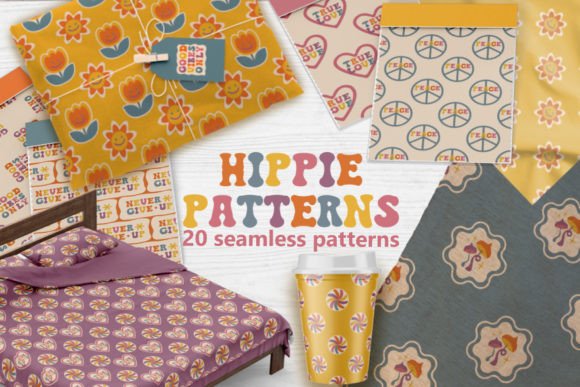
Hippie Patterns 20 Seamless Prints
If you're designing for a brand, product line, or personal project that leans into warmth, authenticity, and joyful rebellion—Hippie Patterns 20 Seamless Prints delivers exactly what you need: twenty cohesive, retro-inspired seamless patterns built for real-world use. These aren’t just nostalgic motifs tossed together. They’re thoughtfully composed repeats featuring eyes, stars, hearts, and hand-drawn inscriptions—all hallmarks of the hippie aesthetic—unified by a consistent, earthy-yet-vibrant color scheme. Whether you’re printing on organic cotton tote bags, wrapping artisanal soap bars, designing custom glassware for a wellness café, or building digital assets for a mindfulness blog, this bundle bridges vintage charm with modern production requirements.
Design Flexibility Without Compromise
Each pattern is delivered in three formats: vector (EPS10), high-res JPG (6250×6250 px at 300 DPI), and PNG (3000×3000 px). That means you can scale a single star-and-heart repeat to cover an entire festival tent backdrop—or shrink it down to a subtle watermark on stationery—without pixelation or distortion. The EPS files retain full editability in Adobe Illustrator or Affinity Designer: adjust colors, isolate elements, or tweak spacing without losing fidelity. The JPGs are print-ready for fabric mills, packaging vendors, or print-on-demand platforms like Spoonflower or Printful. PNGs offer transparency for web overlays, social media banners, or layered mockups in Photoshop or Figma.
Saves Time Where It Counts
Creating seamless patterns from scratch takes hours—even experienced designers often spend multiple iterations aligning edges, balancing density, and ensuring visual rhythm. With Hippie Patterns 20 Seamless Prints, that work is already done. You get twenty distinct, balanced repeats—not variations of one base design. That diversity matters: a yoga studio might use the “Lotus Eye” pattern for mats and the “Peace Sign Constellation” for apparel, while a boutique gift shop could pair “Retro Heart Swirl” on wrapping paper with “Sunburst Inscription” on greeting cards. No need to rework alignment or test tiling behavior—you open, place, and produce.
Consistency Meets Creative Control
The shared color palette—think terracotta, sage, mustard, indigo, and cream—ensures visual harmony across applications. If you’re launching a product suite (e.g., matching tea towels, ceramic mugs, and linen napkins), using patterns from this set gives instant cohesion. Yet the palette isn’t restrictive: because the EPS files are vector-based, you can recolor any element individually. Swap indigo stars for gold, mute sage hearts to olive, or invert a pattern to white-on-black for screen-printed apparel. That flexibility supports branding needs without sacrificing the collection’s retro soul.
Who Benefits Most—and Why
Small business owners selling handmade goods find immediate value: no licensing headaches, no per-use fees, and no need to hire a designer for seasonal updates. A candle maker can refresh labels and box wraps each quarter using different patterns from the set—keeping visuals fresh while maintaining brand recognition.
Freelance surface designers and textile artists use these as starting points: layer them with original illustrations, combine with photography, or deconstruct motifs to build new compositions. Because all files are delivered separately (not embedded in a layered PSD), you retain full control over which elements to use and how to integrate them.
Educators and workshop leaders teaching print design, branding, or craft entrepreneurship appreciate having a real-world asset bundle to demonstrate tiling, color adaptation, and cross-media application—without navigating complex licenses or watermarked previews.
Bloggers and content creators covering wellness, sustainability, or retro culture can enhance posts with authentic, on-brand visuals—custom headers, Pinterest pins, or printable affirmations—without relying on generic stock graphics.
Realistic Fit Considerations
This bundle excels when you want cohesive, ready-to-deploy retro patterning—but it doesn’t include mockups, templates, or editable text layers. If your goal is to drop a pattern directly onto a pre-built Shopify banner template with editable fonts and placeholder photos, you’ll still need to composite those elements yourself. Similarly, while the EPS files are compatible with most vector editors, users of non-Adobe software should verify EPS10 support (Affinity Designer handles it well; older versions of CorelDRAW may require conversion).
The JPG and PNG files are large but optimized for quality—not web speed. For fast-loading website backgrounds, consider exporting smaller, compressed versions. And while the color scheme is intentionally harmonious, it may not match highly specific brand palettes out of the box. That’s where the vector files shine: adjust hues precisely to align with your existing guidelines.
Getting Started Is Straightforward
All files arrive in a single ZIP archive. You’ll need WinZip (or any modern extraction tool like 7-Zip or macOS Archive Utility) to open it—no special plugins or subscriptions required. Once extracted, you’ll find each pattern labeled clearly (e.g., HP07_StarEyes_Seamed.eps, HP07_StarEyes_Print.jpg) so you can locate assets quickly across projects. There’s no activation, no account login, and no recurring fee. You own perpetual usage rights for both personal and commercial work—including physical products, digital downloads, and client deliverables—as long as you don’t resell or redistribute the files themselves.
A Thoughtful Tool for Meaningful Making
Hippie Patterns 20 Seamless Prints works best when you value intention over trend-chasing. It’s not about slapping “vintage” onto everything—it’s about choosing design elements that reflect values like connection, calm, and individuality. A teacher using the “Handwritten Peace” pattern on classroom posters reinforces tone before a single lesson begins. A sustainable fashion label applying the “Leaf & Eye” repeat to organic denim signals ethos through texture and motif. Even in digital spaces, these patterns add tactile warmth to otherwise flat interfaces—softening UI elements or grounding landing pages with analog-inspired rhythm.
That resonance comes from attention to detail: the slight irregularity in line weight, the intentional spacing between symbols, the balance of positive and negative space. These aren’t algorithmically generated repeats—they carry the quiet confidence of hand-informed design, scaled for today’s production demands.
If you’ve ever spent hours searching for *just* the right groovy background—only to hit limits on resolution, licensing scope, or visual fatigue—this set offers relief. Not as a shortcut, but as a foundation: reliable, expressive, and quietly versatile. It won’t replace your creative judgment—but it may free up the time and mental space to apply it where it matters most.