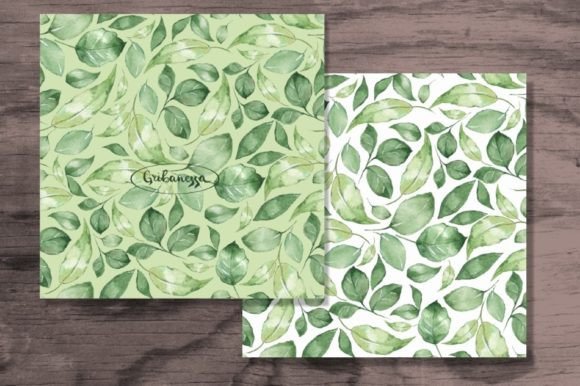
Green Leaves. Watercolor Patterns
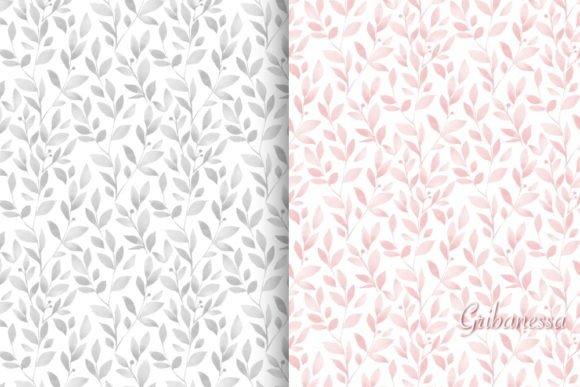
Watercolor textures carry a quiet authority—soft edges, organic flow, and subtle depth that digital brushes often struggle to replicate authentically. Green Leaves. Watercolor Patterns delivers two distinct, hand-painted botanical motifs rendered in rich, natural greens: one with delicate veined foliage layered in translucent washes, the other featuring bolder, clustered leaves with gentle granulation and soft halos of pigment bloom. These aren’t clipart or vector abstractions—they’re true watercolor scans, captured at 3600×3600 pixels and 300 dpi, preserving every paper tooth, pigment lift, and feathered boundary.
Why resolution and authenticity matter—for real projects
Many free or low-cost leaf patterns sacrifice fidelity for convenience: pixelated edges, flattened color, or artificial repetition that breaks immersion. With Green Leaves. Watercolor Patterns, the high-resolution JPG files retain integrity across scales. Print a 24×36″ wall art piece, and the texture remains tactile—not blurry or posterized. Enlarge a section for a greeting card border, and the subtle variation in leaf tone stays nuanced, not oversaturated or muddy. That fidelity translates directly into perceived professionalism—whether you’re designing wedding invitations for a client or assembling a memory album for your child’s first year.
Practical versatility—beyond “just” backgrounds
These patterns work hardest when treated as foundational elements—not just filler. For scrapbookers, layer one pattern beneath handwritten journaling on vellum to add warmth without competing with text. For fabric designers, tile the image seamlessly (using Photoshop’s Offset filter or Affinity Photo’s Repeat Editor) to create custom-printable yardage for eco-conscious apparel or home goods. Educators printing nature-themed classroom posters find the organic green tones easier on young eyes than fluorescent vector graphics—and the realism supports observational learning about leaf structure and light interaction.
Time saved where it counts
Creating original watercolor textures from scratch demands materials, drying time, scanning calibration, and color correction—often 2–4 hours per usable motif. Green Leaves. Watercolor Patterns eliminates that bottleneck. You get production-ready files: no transparency issues (clean white backgrounds), no licensing ambiguity (personal and commercial use included), and no need to wrestle with blending modes to mute intensity. A freelance graphic designer preparing three invitation suites for spring clients can drop one pattern into a layout, adjust opacity to 15%, and move on—freeing mental bandwidth for typography pairing or envelope calligraphy.
Who benefits most—and why
- Small business owners launching seasonal product lines (e.g., botanical tea packaging or handmade soap labels) gain cohesive, earthy visual language without commissioning custom illustration.
- Educators and homeschoolers use the patterns to create printable nature study guides, laminated sorting cards, or calming classroom borders—no subscription required.
- Paper crafters and cardmakers appreciate how the 300 dpi resolution holds up under die-cutting and embossing; faint watercolor grain adds dimension even after physical manipulation.
- Bloggers and content creators designing Pinterest-optimized infographics or printable planners find the green palette aligns with wellness, sustainability, and growth themes—without leaning into clichéd “eco” tropes.
A note on fit and thoughtful application
These patterns excel in contexts valuing subtlety and craftsmanship—but they’re not universal solutions. If your project requires sharp geometric contrast (e.g., tech startup branding), the softness of watercolor may dilute impact. Similarly, for large-scale textile repeats, test tiling first: while both files are designed for seamless adaptation, slight variations in pigment density mean minor manual blending may optimize continuity across very wide fabrics. And because they’re JPGs—not layered PSDs—you won’t be able to isolate individual leaves for repositioning. That’s intentional: these are meant as unified atmospheric elements, not modular components.
Real-world integration tips
Try these approaches to deepen utility:
- For gift wrapping: Print one pattern on kraft paper using an inkjet printer with matte finish settings. The watercolor texture absorbs ink beautifully, yielding a luxe, handmade look without specialty paper costs.
- For digital presentations: Overlay a 10% opacity version of the lighter leaf pattern behind slide titles in PowerPoint or Keynote. It adds quiet sophistication without distracting from data or speaker notes.
- For DIY wall art: Print both patterns on heavyweight watercolor paper (like Arches 300gsm), then lightly distress edges with sandpaper before framing. The physical texture echoes the painted origin—making the artwork feel intentionally crafted, not downloaded.
Supporting creative confidence—not just output
Creative work often stalls not from lack of ideas, but from friction: sourcing assets that match your vision, troubleshooting print quality, or second-guessing whether a green tone reads as “fresh” or “muddy.” Green Leaves. Watercolor Patterns reduces that uncertainty. The colors are calibrated for consistency across screen and print (tested on Epson and Canon pigment printers), and the leaf forms avoid overly stylized or cartoonish interpretations—landing instead in a sweet spot between botanical accuracy and artistic interpretation. That reliability lets you focus on what matters: the story in your album, the emotion in your invitation wording, the clarity of your lesson plan.
Gribanessa’s attention to technical detail—3600×3600px dimensions, true 300 dpi, clean JPG delivery—reflects an understanding that creators need tools that behave predictably. No hidden upsells, no complex licensing tiers, no asset packs bloated with unusable variants. Just two focused, high-fidelity patterns rooted in real watercolor practice. That restraint is rare—and valuable.
Whether you’re prototyping a new stationery line, prepping a classroom for a botany unit, or wrapping a birthday present with intention, Green Leaves. Watercolor Patterns offers quiet, grounded support. Not flash. Not filler. Just green—thoughtful, textured, and ready when you are.